Tag: Ecommerce

  • 7 Common Mistakes When Choosing a Fulfillment Partner

    7 Common Mistakes When Choosing a Fulfillment Partner

    In 2025, “Made in USA” Fulfillment is becoming an inevitable trend in the Print on Demand (POD) industry, opening up tremendous opportunities for sellers to conquer the U.S. market with faster delivery, more consistent quality, and sustainable profit growth.

    This article highlights the seven most common mistakes POD sellers make when choosing a fulfillment partner and provides practical guidance on how to select the right one helping you operate more efficiently and build a stronger, long-term presence in the U.S. market.
    Fulfillment Partner

    Choosing a Fulfillment Partner Based Solely on Low Price While Ignoring Service Quality

    One of the most common mistakes sellers make is prioritizing cheap prices over quality. Many new sellers are easily attracted by offers like “T-shirt printing for $3” or “U.S. shipping for only $5” without taking the time to thoroughly evaluate the service behind those claims.

    Low prices aren’t necessarily bad but if the cost seems unreasonably low, it often means the provider has cut corners somewhere: skipping quality control steps, using cheap printing materials, or outsourcing to third parties they can’t fully supervise.

    The Serious Consequences

    Poor-quality blanks: “Cheap” often comes with second- or third-grade T-shirt blanks. The fabric is thin, stitching is sloppy, and the shirts shrink or fade after just one wash. You might think you’re using a Gildan 5000, but is it an authentic product or a low-grade imitation?

    Disastrous print quality: To cut costs, low-priced print shops often:

    • Skip pre-treatment: They omit the crucial pre-coating layer, causing DTG/DTF ink to fail to bond properly with the fabric, resulting in faded or “washed-out” prints.
    • Use cheap inks: Unverified or low-quality inks that crack, peel, or emit an unpleasant chemical odor.
    • Rely on outdated equipment: Old printers with clogged nozzles lead to streaks, color inaccuracies, and poor resolution.

    In the end, the “savings” you thought you made quickly turn into massive costs, refund processing, lost customer trust, and even reduced visibility or ranking on major marketplaces.

    Failing to Verify Production Capacity and Order Processing Time

    Many sellers focus solely on the price list and overlook production time a crucial factor that directly determines delivery speed.

    An average fulfillment provider may take 4–7 days to print and pack orders, while modern facilities can complete production within just one day, allowing U.S. customers to receive their packages in 2–5 days.

    If you don’t clarify a partner’s production capacity, you may face serious problems when order volumes spike during peak seasons from delays and backlogs to complete operational breakdowns.

    Consequences:

    • Mass order cancellations: Customers cancel before their orders even ship.
    • Lost competitive edge: Your competitor, working with a 2–3 day production partner, has already delivered their orders and earned 5-star reviews while you’re still explaining to buyers that their orders are “in process.”
    • Q4 chaos: During peak seasons (Black Friday, Christmas), a 7–10 day production time can balloon to 15–20 days, meaning your “Christmas orders” might arrive after New Year’s.

    Solution: Always request a clear Service Level Agreement (SLA) outlining production, packaging, shipping timelines, and defective-order handling. A U.S.-standard fulfillment provider like FlashShip guarantees 1-day production and 2–5 day domestic delivery, helping sellers maintain both speed and credibility.

    Lack of Transparency in Costs and Operational Processes

    One of the most costly mistakes sellers often make is focusing only on the base cost (blank + print) and the basic shipping fee, while neglecting to examine hidden charges and the transparency of their fulfillment partner’s operations.

    Many low-cost fulfillment providers attract sellers with appealing advertised rates, but hide numerous surcharges in the fine print of contracts or service-level agreements (SLAs) that few people take the time to read carefully.

    The Consequence: The “Iceberg Effect” of Hidden Fees Eating Away Your Profit

    The price you see upfront is just the tip of the iceberg, the hidden costs beneath the surface are what truly erode your profit margins. Common examples include:

    • Storage fees: Many POD sellers overlook this. If a design doesn’t sell well, or if returned products remain in the warehouse without immediate action, you may be charged storage fees per day, week, or cubic meter.
    • Return handling fees: When customers send back items, the fulfillment provider incurs labor costs to receive, inspect (QC), restock, or dispose of them. Many partners quietly deduct these fees from your account.
    • Special packaging fees: Want to use custom-branded boxes instead of standard poly mailers? Want to include thank-you inserts or cards? These extras often come with additional per-order charges.
    • Brand labeling fees: Costs for removing original tags and printing, sewing, or applying your own branded labels.

    If you don’t review these terms carefully, your actual cost per order can end up 20–30% higher than your original estimates, completely disrupting your profit calculations.

    Solution: Request Detailed Quotations and Full Transparency

    To protect your business, you need to take a proactive approach from the very beginning:

    • Request a detailed quotation: Never accept a vague or lump-sum quote. Ask your fulfillment partner to break down every cost item, including blank product fees, printing fees, handling fees, shipping costs, and any other potential surcharges.
    • Prioritize partners with public pricing: A reputable provider (like FlashShip) will openly display its pricing tables and fee policies on its website. This transparency reflects both credibility and confidence in their service quality.
    • Ask specific process questions: For example, “How are returns handled, and what are the associated costs?” or “Does the shipping fee include tracking and insurance coverage?”

    Remember, a great fulfillment partner is not necessarily the cheapest one, it’s the one that helps you clearly control your costs and maximize profits sustainably in the long run.

    Ignoring the Location of the Fulfillment Facility

    Fulfillment Facility

    A major strategic mistake many POD sellers make is focusing solely on print pricing without asking the crucial question: “Where is your facility located?” The warehouse location directly impacts two vital factors delivery speed and shipping cost every single day.

    The Consequences of a Poorly Located Facility

    Imagine your fulfillment partner’s warehouse is in California (West Coast), but your order needs to be shipped to New York (East Coast). The delivery time could take 2–3 extra days compared to estimates. Conversely, if the warehouse is on the East Coast, your West Coast customers will experience the same delays.

    These geographical mismatches don’t just reduce customer satisfaction they also increase shipping costs due to longer distances.

    The Solution: Prioritize a Central “Logistics Gold Zone”

    Fulfillment hubs located in central states like Texas hold a significant strategic advantage. Often called the “heart of U.S. logistics,” a warehouse in Texas offers:

    • Balanced shipping distances: Orders to both East and West Coasts have nearly equal delivery times.
    • Consistent delivery speed: Enables you to confidently maintain uniform shipping commitments across the entire U.S.
    • Optimized shipping costs: Centralized routes typically reduce shipping expenses by 15%–25% compared to coast-to-coast shipping.

    Lesson: Always check your fulfillment partner’s shipping coverage map and prioritize those with centrally located warehouses. This is precisely why experienced POD sellers regard FlashShip as a true “logistics gold zone” the ideal hub for anyone aiming to dominate the U.S. market.

    Overlooking System Integration and Automation

    Overlooking System Integration and Automation

    In the era of multichannel selling, professional POD sellers often manage orders across multiple platforms such as Etsy, Shopify, Amazon, or TikTok Shop. A fatal mistake is choosing a fulfillment partner that lacks a strong automated API integration system.

    Without automation, you’ll be forced to handle every order manually, downloading files, sending emails, and entering data by hand. This process isn’t just time-consuming; it’s also extremely prone to errors.

    The Consequences of Manual Operations

    Common problems caused by the lack of system integration include:

    • Order mistakes: Duplicated orders, incorrect SKUs, mismatched designs, wrong sizes, or colors.
    • Wasted time on updates: You’ll need to manually upload tracking numbers for each order on every platform. Any delay can severely damage your store’s reputation on Etsy or Amazon.
    • Information blind spots: Without real-time tracking, you can’t monitor inventory or production status (pending, printing, shipped), making customer support and operations harder to manage.

    The Solution: Choose an All-in-One Management Platform

    The answer is to prioritize fulfillment partners with strong technological infrastructure. You need an All-in-One management system capable of:

    • Automatically syncing data across all your sales channels.
    • Updating order status in real time.
    • Providing clear, detailed operational reports.

    A robust automation system saves time, reduces human error, and helps your POD business scale efficiently, something a manual workflow simply can’t achieve.

    Failing to Review Customer Support and Service Policies

    A critical mistake many POD sellers make is focusing solely on production speed and pricing, while completely overlooking the human element, customer support when issues arise.

    The Consequences of “Disappearing Support”

    The POD world isn’t always perfect. There will be times when orders are misprinted, lost, or customers request returns. Now imagine this: in an urgent situation, you submit a support ticket and wait 3–5 days just to receive a generic response.

    Such delays not only waste precious time during a crisis but can also result in losing the customer permanently, often accompanied by a 1-star review.

    The Solution: Choose a “Partner,” Not Just a “Printer”

    Before committing to any fulfillment provider, make sure to:

    • Carefully review policies: Read the terms related to refunds, reprints, and returns. Is their error-handling process clear and transparent?
    • Prioritize multilingual support: For Vietnamese sellers targeting international markets, a bilingual (Vietnamese–English) support team is invaluable, ensuring clear communication and faster problem resolution.
    • Check response time: A professional partner should guarantee support response within 24 hours  ideally via live chat.

    A trustworthy fulfillment provider doesn’t just deliver fast; it stands by your side when problems occur. That’s the key difference between a basic print factory and a true fulfillment partner.

    Failing to Evaluate Credibility and Community Feedback

    Another costly mistake many POD sellers make is choosing a fulfillment partner blindly  without taking the time to assess their reputation and real feedback from the seller community. You don’t want to be the next person to “test and fail.”

    Many sellers have found themselves in frustrating situations: partners failing to meet promised production times, printing errors across entire winning campaigns, or worse  disappearing completely when issues arise.

    The Solution: Be a Smart “Detective” Before You Partner Up

    Before entrusting your business to any fulfillment provider, take the initiative to verify their credibility:

    • Read cross-platform reviews: Don’t rely solely on their website. Check discussions and feedback from large POD communities on Facebook, Reddit, or reputable review sites like Trustpilot.
    • Verify legal and operational information: When were they founded? Is their website professional and transparent? Ask for real photos or videos of their facilities and printing equipment.
    • Prioritize transparency: Choose a partner with clear policies, well-documented procedures (such as reprint/refund terms), and a professional seller support team.

    A reputable fulfillment provider isn’t defined by low prices or flashy marketing, but by consistency in quality, speed, and genuine positive experiences from the seller community they serve.

    How to Choose the Right Fulfillment Partner for POD Sellers

    Fulfillment Partner

    After understanding the seven common mistakes, here are the key criteria to help you choose the right fulfillment partner:

    Production and Shipping Speed

    In the e-commerce world, speed is king. Customers have become accustomed to Amazon Prime’s two-day delivery and will not tolerate waiting two to three weeks for a T-shirt. You need a partner who can guarantee exceptional turnaround times.

    • Ideal production time: The golden standard is 1–2 business days. This means that once an order is pushed to the system, your partner should be able to produce and ship it within 24–48 hours.
    • U.S. domestic shipping time: Must be 2–5 business days.
    • Total fulfillment time: From the moment the customer clicks “Buy” until the package arrives at their doorstep, keeping it under 7 days provides a powerful competitive edge, reducing cancellation rates and significantly increasing 5-star reviews.

    Print Quality and Quality Control (QC) Process

    Fast speed means nothing if the product you deliver is poor quality. The product represents your brand, never compromise on it.

    • U.S.-standard printing technology: Your partner should use modern machinery and certified inks for core printing methods such as DTG (Direct-to-Garment), DTF (Direct-to-Film), and 2D/3D printing (for mugs, phone cases, etc.). This ensures sharp prints, accurate colors, and long-lasting vibrancy even after multiple washes.
    • QC process: Require your partner to have a strict multi-step quality control procedure (at least two stages, before and after printing) to eliminate defective, misprinted, dirty, or damaged products before they are packed and shipped.

    Transparent Costs and Operational Reporting

    Profit lies in the details and hidden fees are the number one enemy of POD sellers. A reliable partner must offer 100% financial transparency.

    • Clear pricing, no hidden fees: Request a detailed cost breakdown for everything — blank product price, printing fee, shipping fee, return handling fee, storage fee (if applicable), labeling fee, and more.
    • Tracking dashboard: Choose a partner that provides a dashboard system allowing you to monitor costs and profits per order. This helps you make business decisions based on real data, not guesswork.

    Technology Integration and API Connectivity

    This is the factor that determines whether your business can truly scale or not. If you have to handle orders manually, you’ll never be able to process 1,000 orders a day.

    • Automatic synchronization: Your partner must have a robust API system that enables seamless integration and automatic order syncing across platforms.
    • Real-time status updates: As soon as an order is produced and shipped, the tracking information should automatically sync to your store and be sent to your customers. This eliminates manual errors and frees up your time for growth-focused tasks.

    Professional and Friendly Customer Support

    When problems arise (and they inevitably will), you need an ally, not a soulless call center.

    • Fast and responsive support: Look for a fulfillment partner with a dedicated seller support team ideally bilingual (Vietnamese–English) that can resolve issues quickly and commit to responding within 24 hours.
    • Transparent reprint/refund policy: Their policy should be clear, fair, and focused on protecting the seller’s reputation when errors are caused by the manufacturer. A fair, seller-friendly policy reflects a provider’s confidence in the quality of its service.

    FlashShip – The U.S.-Standard Fulfillment Solution Designed for Vietnamese POD Sellers
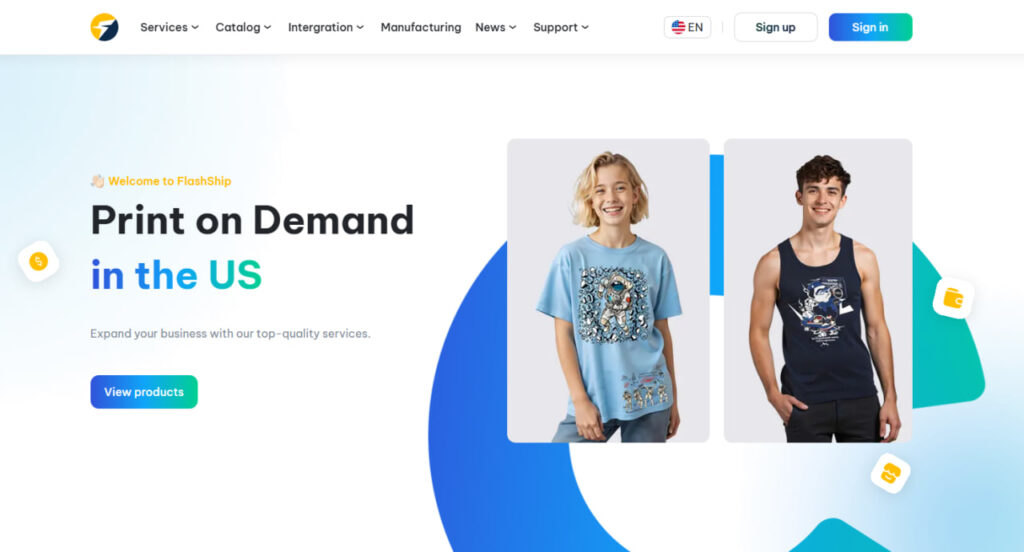
    FlashShip

    FlashShip is a fulfillment provider built specifically for the Vietnamese POD seller community targeting the U.S. market, featuring a fully domestic production system and a smart management platform.

    Texas – The “Golden Hub” for 2–5 Day Nationwide Delivery

    Say goodbye to slow and expensive cross-country shipping. FlashShip’s central hub is strategically located in Texas, the heart of America’s logistics network.

    • Superior speed: This strategic location allows balanced delivery to both the East and West Coasts, ensuring stable U.S. domestic delivery times of just 2–5 business days.
    • Optimized costs: Shipping from the center of the country significantly reduces transportation costs compared to coastal warehouses, helping you maximize profit margins on every order.

    Fast Production (From 1 Day) – Sharp, U.S.-Standard Print Quality

    Don’t let long production times hold back your Q4 revenue.

    • Production starting from 1 day: Our automated system allows orders to enter production almost instantly after being placed.
    • Premium print quality: We use U.S.-standard printing technologies (DTG, DTF) and certified inks to ensure every print is vivid, sharp, and colorfast.
    • Double-layer QC: Every product undergoes a strict two-step quality control process before packaging, minimizing return rates and ensuring customer satisfaction.

    Seller V2 Platform – The All-in-One “Brain” of Your Business

    Forget manual order processing – FlashShip Seller V2 is the intelligent control center that powers your entire POD business.

    • Powerful API Integration: 100% of your orders are automatically synced in real time.
    • Real-Time Management: A unified dashboard gives you full visibility into every stage from production and shipping to revenue and profit tracking.
    • Smart Reporting: Access visual, data-driven insights that help you make informed decisions, forecast trends, and optimize costs effectively.

    Breaking Barriers with Professional Bilingual (Vietnamese–English) Support

    We speak your language literally. Don’t let language barriers or time zone differences slow down your business.

    • 24/7 Vietnamese–English Support: Our professional bilingual support team, deeply experienced in POD operations, is ready to resolve your issues quickly and efficiently.
    • End-to-End Assistance: We accompany you through every step from account setup and store integration to operational optimization.
    • Market Updates: Receive continuous access to resources, guides, and U.S. POD market insights, helping you stay one step ahead of the competition.

    “Made in USA” Fulfillment is not just a new trend it is a strategic breakthrough that empowers Vietnamese POD sellers to gain a stronger competitive edge in the U.S. market. When your products are printed and shipped domestically, you significantly reduce logistics costs, shorten delivery times, and build a professional, trustworthy brand image with the “Printed in the USA” label.

    If you’re looking for a U.S.-standard fulfillment partner, contact our hotline at (+84) 943 024 337 or visit https://flashship.net for detailed consultation, quick quotations, and to develop an effective “Made in USA” fulfillment strategy for your POD brand.

  • 10+ T-Shirt Design Notes to Boost Your POD Sales

    10+ T-Shirt Design Notes to Boost Your POD Sales

    In the competitive world of Print on Demand (POD), a well-designed t-shirt does more than just catch the eye it directly impacts your sales performance. With thousands of products on e-commerce platforms like Etsy, Amazon, TikTok Shop, and Walmart, creating standout, trend-driven t-shirt designs is the key to seller success.

    This article will share 10+ essential design tips to help you not only improve product quality but also boost conversion rates and maximize revenue.

    DTF

    Basic Principles of POD T-Shirt Design

    Before diving into advanced tips, it’s essential to understand the basic principles of POD t-shirt design. These fundamentals serve as the foundation to ensure your products are high-quality and appealing to customers.

    T-Shirt Blank Quality

    Think of the t-shirt blank as a canvas and your design as the artwork. A poor-quality canvas can never do justice to a beautiful painting. Similarly, an outstanding design printed on a low-quality shirt with thin, easily stretched fabric will immediately diminish the product’s value and leave customers disappointed. This not only leads to negative reviews but can also harm your brand’s reputation in the long run.

    Choosing a reliable t-shirt blank supplier is crucial for success. Here are some of the most popular and trusted options among the POD seller community:

    • Gildan 5000: The “go-to” choice for many sellers, known for its affordable price, consistent quality, and classic fit. Perfect for bulk campaigns or targeting customers who prioritize budget-friendly options.
    • Bella + Canvas 3001: Known for its soft, lightweight, and breathable fabric, this shirt provides a premium, fashionable feel. It’s ideal for trendy designs aimed at younger audiences seeking style and comfort.
    • Comfort Colors 1717: True to its name, this shirt delivers exceptional comfort with its thick, durable fabric. It features a garment-dyed finish that creates a unique vintage effect, making it perfect for retro or nostalgic designs.

    Pro Tip: Don’t hesitate to order samples from suppliers. Feel the fabric yourself, check the stitching, and even wash the shirt to test colorfastness before deciding to make it a flagship product in your store.

    Technical Specifications

    A design that looks stunning on screen can turn into a disaster when printed if you don’t follow proper technical requirements. To ensure your prints are always sharp, vibrant, and free from blurriness or pixelation, keep these key points in mind:

    • Resolution: Always set your design file to a minimum resolution of 300 DPI (dots per inch). This is the gold standard in the printing industry to guarantee the highest image quality.
    • Dimensions: Use the recommended standard sizes provided by POD platforms. A common and safe size is 4500 x 5400 pixels, which is optimal for print areas on most t-shirt types.
    • Transparent Background: Save your design in PNG format with a transparent background. This allows you to apply the design to any shirt color without unwanted white or black boxes appearing behind the artwork.

    The Power of Color

    Color isn’t just for decoratio,  it has the power to evoke emotions and convey messages. A thoughtfully chosen color palette can make your design stand out and create a stronger connection with your customers.

    • Limit Your Color Palette: To keep your design professional and visually appealing, limit your color palette to 3–4 main colors.
    • Check Contrast Levels: Always test your design on mockups with both light and dark shirt colors. For instance, a black element will disappear on a black shirt. Make sure every detail remains visible and clear across various shirt colors to give customers more options.

    Understanding Your Target Audience

    Designing isn’t about creating something for yourself, it’s about creating for your customers. Before you start sketching, take time to research and answer these key questions:

    • Who are they? Consider their gender, age, occupation, interests, and who they follow on social media.
    • What do they care about? Identify the stories, quotes, or images that will resonate with them emotionally or make them laugh.
    • Why are they buying the shirt? Is it to express their personality, to give as a gift, or to wear at a specific event?

    Advanced Tips to Make Your T-Shirt Designs Stand Out

    Once you’ve mastered the basics, it’s time to elevate your designs and gain a competitive edge in the POD market.

    Optimize the “First Glance” to Capture Attention in 3 Seconds

    On e-commerce platforms, customers scroll through hundreds of products in just a few minutes. You only have about 3 seconds to grab their attention before they move on. That’s why your design needs to create an instant visual impact.

    • Create a strong focal point: The main element of your design—whether it’s an image or text should take up about 60–70% of the space and be positioned at the center. This creates a clear point of focus, allowing customers to grasp the message immediately.
    • Prioritize clarity: Use bold, large, and easily readable fonts that stand out even in thumbnail view. Avoid overly small details or thin lines that may disappear on a smaller screen.
    • Leverage the power of negative space: Don’t overcrowd your design with too many elements. Adequate spacing around key components makes the design look clean, professional, and draws attention to the core message.
      For example, a shirt with the bold text “DOG DAD” paired with a simple dog silhouette will be far more effective than a cluttered design with multiple images and tiny text.

    Stay Ahead of Trends

    Designing with trends in mind is one of the fastest ways to create seasonal bestsellers. However, staying on top of trends requires both agility and strategy.

    • Use smart tools:
      • Google Trends: Helps you identify keywords, topics, or events experiencing a surge in search volume. This is a goldmine for spotting potential “hot trends.”
      • Marketplace search tools (Etsy, Amazon): Type in a niche keyword (e.g., “vintage floral shirt”) and look at Bestseller listings. Analyze what they have in common in terms of color schemes, layouts, and styles.
      • Social media (Pinterest, TikTok, Instagram): These platforms are at the forefront of aesthetic trends. Search hashtags like #tshirtdesign or #styleinspo for endless inspiration on what styles are currently popular.
    • Plan ahead for major holidays:
      Events like Halloween, Christmas, Mother’s Day, and Valentine’s Day are peak seasons for POD. Prepare and upload relevant designs at least 1–2 months in advance. This gives your products enough time to be indexed by marketplace algorithms and displayed to customers right when demand spikes.

    Professional Typography

    In text-based designs, typography is the soul of your artwork. The right font can elevate the entire design, while the wrong choice can ruin it completely.

    • Invest in high-quality fonts: Use professionally designed fonts that ensure readability and have clear commercial licensing.
    • Match the theme: Choose fonts that reflect the “personality” of your message.
      • Example: Handwritten fonts work well for vintage or retro themes, while bold, sans-serif fonts like Montserrat or Bebas Neue are ideal for minimalist or inspirational designs.
      • Avoid fonts that are too thin, making them hard to read when printed, or overly ornate, which can appear cluttered and distracting.

    Diversify Your Options

    Don’t limit your customers. The same design can appeal to different audiences simply by offering it on a variety of shirt colors. Providing multiple color options increases the chances of closing a sale, as customers are more likely to find a version that suits their personal style.

    Make sure your design looks great on at least three color groups:

    • Light colors: White, cream, and pastel shades (light pink, mint green).
    • Dark colors: Black, navy blue, deep olive green.
    • Neutral colors: Gray, charcoal, beige.

    Optimize for Production (Fulfillment)

    POD

    A perfect design should ensure a smooth printing process. Production errors not only increase costs but also reduce customer satisfaction.

    • Follow the Safe Area Guidelines: Always keep important elements of your design within the safe print area specified by your fulfillment provider. This prevents parts of your design from being cut off during the printing process.
    • Check diverse mockups: Don’t just preview your design on t-shirts. Test it on other products you plan to sell, such as hoodies, sweatshirts, and tote bags. A design that looks great on a t-shirt may need size or placement adjustments to fit a hoodie with a front pocket.
    • Consider DTG printing limitations: DTG (Direct to Garment) is the most common printing method in POD. However, it may struggle with ultra-fine details, overly complex gradients, or transparency effects. Keep your design clear and straightforward to ensure the final print maintains the highest quality.

    Common Mistakes to Avoid in POD T-Shirt Design

    A great design can drive breakthrough sales, but even a small mistake can ruin everything. For POD sellers, recognizing and avoiding common pitfalls is crucial for success.

    Here are some classic mistakes you should keep top of mind to ensure your designs stay on track.

    Overly Complicated and Hard-to-Read Designsp

    In the digital world, you only have 3–5 seconds to grab a customer’s attention as they scroll through products. A design that’s overloaded with details, overly complex, or has a confusing message will be quickly ignored.

    • Customer mindset: Shoppers are looking for a shirt that clearly expresses their personality or delivers a message they can connect with instantly. If they have to “decode” your design, they’ll simply move on to a simpler, more straightforward option.

    Solutions:

    • Prioritize simplicity: Focus on a single idea, one main visual element, or one strong slogan.
    • Leverage negative space: Give your design “room to breathe.” This helps highlight the main element and creates a clean, professional look.
    • Ensure readability: Choose fonts that are clear and legible, even from a distance or when viewed as a small thumbnail. Also, check the contrast between text/image colors and the shirt background to make sure everything is easy to see.

    Using Copyright-Infringing Images

    This is the most serious mistake you can make, it’s like a “death sentence” for your POD business. Copyright infringement can lead to your shop being permanently banned from platforms like Merch by Amazon, Etsy, TikTok, Redbubble, and more. Worse, it can result in costly legal issues.

    Content you must absolutely avoid:

    • Logos, characters, or symbols from Disney, Marvel, DC Comics, Nintendo, etc.
    • Names or logos of well-known brands (Nike, Adidas, Gucci), sports teams, or music bands.
    • Quotes from movies, song lyrics, or copyrighted books.
    • Images of celebrities or politicians without explicit permission.

    Safe solutions:

    • 100% original designs: The most sustainable and safest approach is to create everything yourself.
    • Use legal resources:
      • Free resources for commercial use: Unsplash, Pexels (for photos), Freepik, Pixabay (with free options).
        Note: Always read the license terms carefully before using.
      • Paid resources: Creative Fabrica, Vexels, and Envato Elements are excellent platforms with massive libraries of graphics designed specifically for POD sellers. The investment is minimal compared to the risks of copyright violations.

    Not Checking Mockups Before Listing

    A mockup is a visual representation of your design on an actual product. Skipping this step is like selling a house without showing any pictures. Without mockups, customers can’t visualize the scale, colors, or placement of your design on the shirt, which significantly lowers your conversion rates.

    Why mockups matter:

    • Build trust: High-quality, realistic mockups make your product look professional and credible.
    • Visualize the product: Help customers imagine what they’ll look like wearing the shirt.
    • Catch design errors: Identify issues such as a design being too large or too small, poorly placed, or having colors that don’t match well with the shirt color.

    Solutions:

    • Always prepare at least 3–5 mockup images for each product, showing different angles and contexts (e.g., flat lay mockups, model wearing mockups).
    • Ensure the mockup colors are accurate and consistent with the actual color options provided by your supplier.
    • Use tools like Placeit or professional PSD mockup files to create attractive and realistic product images.

    Lack of Style Consistency (Brand Identity)

    A store where every product has a completely different style for example, one minimalist design, one cartoon chibi design, and one retro design can confuse customers and fail to establish a recognizable brand identity.

    Why consistency matters:

    Consistency helps build brand recognition, foster a loyal customer base that loves your style, and encourages repeat purchases.

    Solutions:

    • Identify 2–3 core styles that you do best and that align with the niche market you’re targeting.
    • Develop a basic brand identity system, including a consistent color palette, a few signature fonts, and a cohesive illustration style applied across all designs.

    When customers see one of your designs, they should immediately recognize it and think, “Oh, that’s from Shop X!”  and that is the ultimate goal of building a strong brand.

    Tools & Inspiration for T-Shirt Design

    DTF

    Turning ideas into best-selling products requires the right design tools and a constant source of creative inspiration. Whether you’re a beginner or an experienced designer, the following “weapons” will help you streamline your workflow and boost your sales.

    Must-Have Design Tools

    Choosing the right tools directly impacts both the efficiency and quality of your designs.

    • Canva:
      The perfect choice for beginner sellers. With its intuitive drag-and-drop interface and vast resource library, Canva makes it easy to create professional-looking typography designs quickly and effortlessly.
    • Adobe Photoshop & Illustrator:
      The industry-standard duo for those who want full creative control.

      • Illustrator excels at creating sharp vector graphics, ideal for logos and slogans.
      • Photoshop is powerful for photo editing and complex visual effects.
    • Placeit:
      A lifesaver for creating high-quality mockups. This platform offers thousands of realistic t-shirt mockup templates, making your products look professional and attractive without needing photography skills.
    • Procreate (iPad):
      Perfect for those who love hand-drawn illustration. Procreate allows you to create exclusive, custom artwork, helping your brand stand out from competitors with truly unique designs.

    Endless Sources of Design Inspiration

    Powerful tools are most effective when paired with breakthrough ideas. Here are some platforms to help you spark creativity and stay ahead of trends:

    • Pinterest & Etsy:
      Two absolute goldmines for market research and t-shirt design inspiration.

      • Pinterest is perfect for exploring visuals, color palettes, and typography trends.
      • Etsy allows you to see which products are actually selling well within your niche.
    • TikTok & Instagram:
      The birthplace of viral trends.

      • Follow trending videos, memes, and hot topics to capture market demand and create timely, shareable designs with high viral potential.
    • Dribbble & Behance:
      Communities of professional designers where you can level up your design mindset.

      • Learn advanced layout techniques, master color combinations, and draw inspiration to create high-quality, standout products.

    Tailored T-Shirt Design Tips for POD Sellers

    To maximize profits and build a sustainable POD brand, sellers need more than just attractive designs they need a smart strategy. Apply these specialized t-shirt design tips to stand out and thrive in the competitive POD market.

    Always Test Samples Before Selling

    In the POD model, you don’t physically handle the products, so ordering a few samples is a wise investment to ensure quality.

    • Check print quality and fabric feel firsthand.
    • Verify color accuracy compared to the mockup.
    • Assess print placement and durability after washing.

    A high-quality product will help you earn 5-star reviews, build customer trust, and reduce the risk of returns and refunds.

    Plan Your Designs Around Seasonal Sales

    Don’t wait until the last minute! POD sales skyrocket during major holidays, so planning ahead is essential.

    • Prepare your designs 1–2 months in advance for peak seasons like Valentine’s Day, Mother’s Day, Halloween, and especially Christmas.
    • Early preparation gives you time to brainstorm creatively, organize marketing campaigns, and capture market share as soon as demand spikes.

    Use Data to Optimize Your Designs

    Avoid designing based on guesswork.

    • Monitor top-selling products on major platforms to understand current trends.
    • More importantly, analyze FlashPOD data to determine which designs your customers love most and which shirt colors are your current best-sellers.

    Data is your compass for success, guiding you to replicate winning designs while phasing out underperforming products.

    Make the Most of FlashShip’s Support

    FlashShip isn’t just a fulfillment partner it’s a launchpad for your success. Take advantage of the FLASHSTART program and receive $20 FREE to get started with zero risk. Use this credit to:

    • Test fulfillment quality: Order samples to personally experience fast shipping (just 1–2 days) and accurate, platform-ready tracking systems.
    • Send products to influencers: A powerful marketing strategy to get authentic review videos that attract new customers.

    In today’s highly competitive POD world, t-shirt design goes beyond aesthetics  it’s a strategic business tool that can determine your shop’s success. A standout, high-quality design helps you build a strong brand identity, win loyal customers, and skyrocket sales, especially during peak holiday seasons.

    Start today by researching the market, choosing the right design style, optimizing every product detail, and applying the insights shared in this guide. Each design isn’t just a t-shirt  it’s a story and a brand value you deliver to your customers.

    FlashShip is committed to walking alongside you at every step  from providing high-quality blanks and cutting-edge printing technology, to U.S. domestic shipping starting from just 2 days, and an intelligent, easy-to-manage fulfillment system. We’re more than a partner; we’re the launchpad that helps POD sellers conquer the global market.

    For product consultation, design advice, or to create an account and start your POD business, contact us today at (+84) 943 024 337 or visit FlashShip.net for dedicated support.